


Studien
Local Public Finances and the Governance of SDGs: Insights from Amsterdam, Barcelona, Bordeaux and Hamburg
The new report “Local Public Finances and the Governance of SDGs: Insights from Amsterdam, Barcelona, Bordeaux and Hamburg” is the first concrete result of the European SLPF project, which aims to make sustainability considerations an integral part of decision-making and public financial management.

News
Second Call for Proposals Launched for the Municipal Exchange Fund “Austria for Ukraine”
Austrian municipalities and municipal partners are invited to submit joint project proposals with Ukrainian municipalities by 30 November 2026. Grants range up to €50,000 per project.

News
Municipal Exchange Fund "Austria for Ukraine" launched
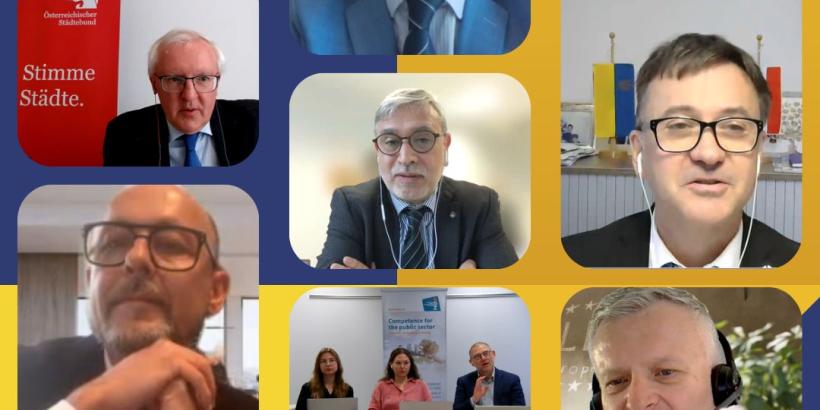
KDZ – Centre for Public Administration Research is pleased to announce the launch of the Municipal Exchange Fund “Austria for Ukraine” (A4U), funded by the Austrian Development Agency (ADA) as part of International Partnerships Austria and the Austrian Association of Cities and Towns (AACT), and in cooperation with U-LEAD with Europe.

Blog
EPSAS Updates 2026
The European Public Sector Accounting Standards (EPSAS) project aims to increase the transparency and comparability of public sector financial accounting and reporting between and within EU Member States by developing and implementing a harmonised European accounting framework. Information on income and expenses, and assets and liabilities, is important for accountability and informed decision-making.

Blog
KDZ Factsheet: Public Employment in Europe
Public employment refers to all individuals working in government institutions and publicly funded organizations, including central and local governments, education, healthcare, public safety, and social services. These employees play a crucial role in delivering essential services, implementing public policies, and ensuring the functioning and stability of democratic systems.

News
Subscribe to the KDZ Newsletter
The KDZ Newsletter informs you about current KDZ projects, topics and activities of interest to the public sector. The KDZ Newsletter is published ten times a year.

News
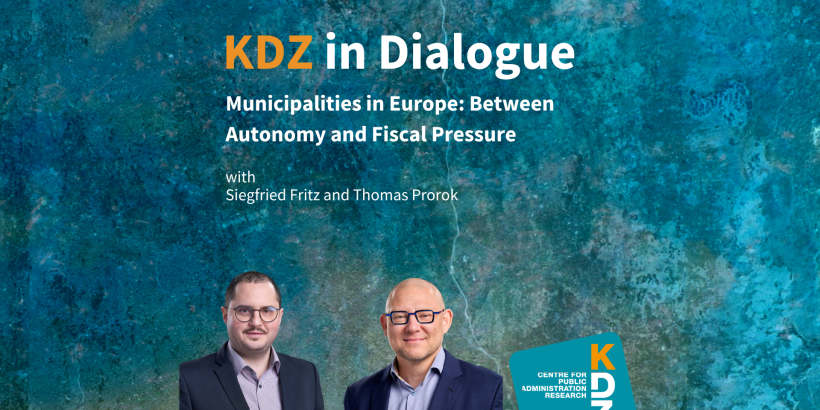
New Podcast: Municipalities in Europe: Between Autonomy and Fiscal Pressure
In this episode of KDZ im Dialog, Siegfried Fritz speaks with Thomas Prorok, Managing Director of KDZ – Centre for Public Administration Research, about municipalities and local governments across Europe.

Blog
Europe's Municipalities Need More Room to Act: Key Lessons from the TERRI Report 2026
Rising responsibilities, constrained financial resources and increasingly complex societal challenges are placing local governments across Europe under growing pressure. The new TERRI Report 2026, published by the Council of European Municipalities and Regions (CEMR), highlights that effective local self-government depends not only on institutional structures and formal responsibilities, but also on adequate financing, administrative capacity and cooperation.

Blog
European Cities Leading the Way in Sustainable Public Finances: The SLPF Project
Cities are crucial in tackling global challenges like climate change and sustainable development. Four leading cities—Amsterdam, Barcelona, Bordeaux, and Hamburg—have joined forces in the SLPF project to integrate the UN's Sustainable Development Goals (SDGs) into their public financial systems. This collaboration aims to drive a sustainable future through innovative financial management.

Blog
From Green Budgeting to Real Choices: What Cities Are Learning About SDG Budgeting
The SLPF project has entered its dissemination phase. After months of joint work with partner cities, the project is now sharing its main outputs, discoveries, and practical lessons with a wider circle of European municipalities.

Blog
Local Governments in Estonia: Money and Responsibility
Estonian residents have high expectations of local governments. We are accustomed to cities and municipalities organising local life and providing high-quality, accessible public services. All of this requires money. At the same time, Estonia is one of the most tax-centralised countries in Europe. In financial terms, local government functions as an extension of central government. In a situation where the state budget is under pressure from defence, health and social expenditure and where public debt is growing rapidly, central government will no longer be able to support local governments financially to the same extent as before.

Blog
Estonia's 2017 Administrative Reform: Lessons from Practice
Estonia’s 2017 administrative reform offers practical lessons on political commitment, public communication and support for municipalities. The experience also highlights the limits of changing boundaries alone: stronger local services require continued attention to funding, responsibilities and regional cooperation.

Blog
How should cities govern what they own? European finance leaders exchange perspectives in Tallinn
Cities across Europe are responsible for far more than their respective core municipal administrations. Public transport operators, utilities, housing companies, infrastructure providers and other municipally owned (semi-public/private) entities often manage significant assets, investments and essential public services. How these organisations are governed therefore matters not only for city finances, but also for the quality, resilience and affordability of services residents rely on every day.
The KDZ - Centre for Public Administration Research is a competence centre and knowledge platform for public management Consulting, European Governance & Urban policy, public finance and federalism and training.
We want a sustainable modernization of the public sector and, as a non-profit organisation, we offer research, advice and training for public administration.







Quicklinks

Kelmend Zajazi | Executive Director of NALAS
The long-term cooperation with KDZ means a lot to us at NALAS. In KDZ we found a peer that fully understands who we are.
Isabelle Verschuren | Federal Public Service Policy and Support (BOSA), CAF correspondent of Belgium
In the last years Belgium has planned and organised many different CAF activities (e.g. CAF training, Certification of CAF label) together with KDZ.
Josep Medrano | Director of Strategic Planning and Taxation, City of Barcelona
For the City of Barcelona, the collaboration with KDZ through the European "Cities for Sustainable Public Finances (CSPF)" has reached a qualitative advance.


