
24.03.2026
Public employment refers to all individuals working in government institutions and publicly funded organizations, including central and local governments, education, healthcare, public safety, and social services. These employees play a crucial role in delivering essential services, implementing public policies, and ensuring the functioning and stability of democratic systems.
In Europe, public employment patterns vary significantly across countries due to differences in governance models, welfare state traditions, population size, and administrative structures. By examining the share of public employees and their distribution across populations, we gain valuable insights into how governments organize themselves to serve citizens effectively.
Persons in Public Employment
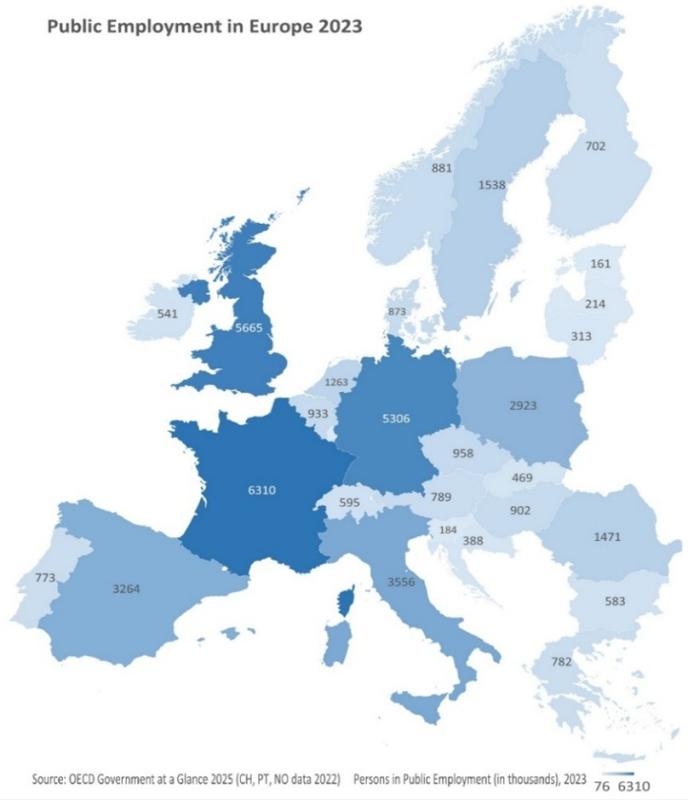
The following map illustrates the absolute number of people employed in the public sector across Europe in 2023. Altogether, 35.272 million people work in public employment across the European Union1.
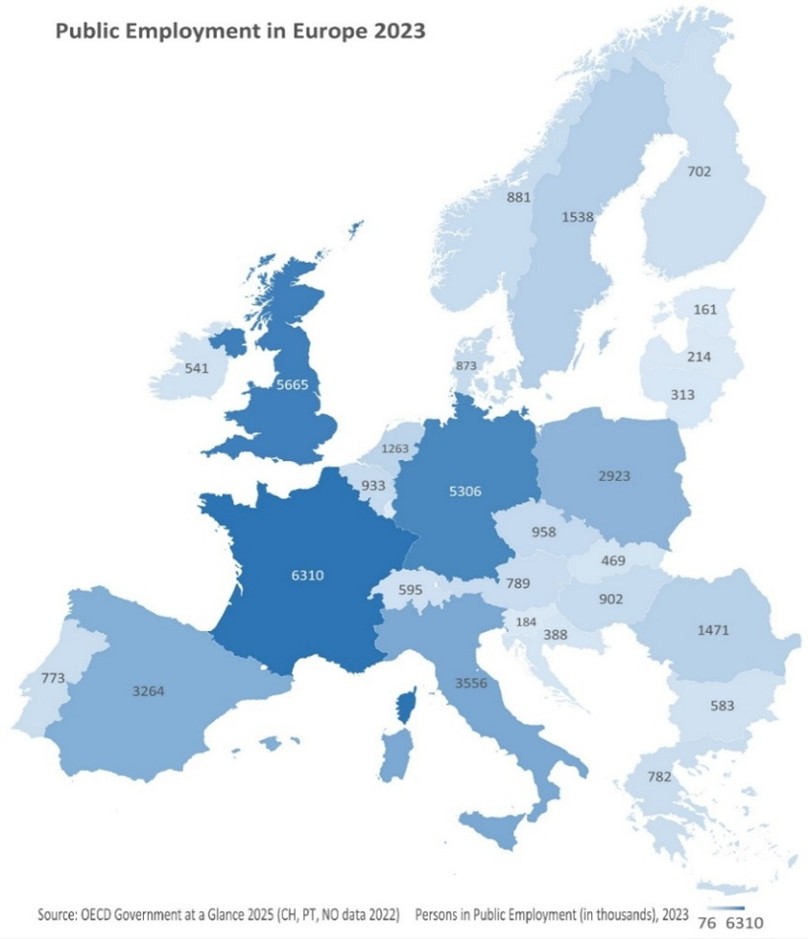
The largest numbers of public employees are found in France, the United Kingdom, and Germany, while the Baltic states, Slovenia, and Croatia record comparatively low figures. However, these absolute numbers should be interpreted carefully, as they are largely influenced by population size: countries with more residents naturally require more public employees. Therefore, the map says more about the demographic scale of countries than about the relative size or performance of their public sectors. For more meaningful comparisons, the indicators “public employment per capita” and “public employment as a share of total employment” are presented.
Public Employment per Capita
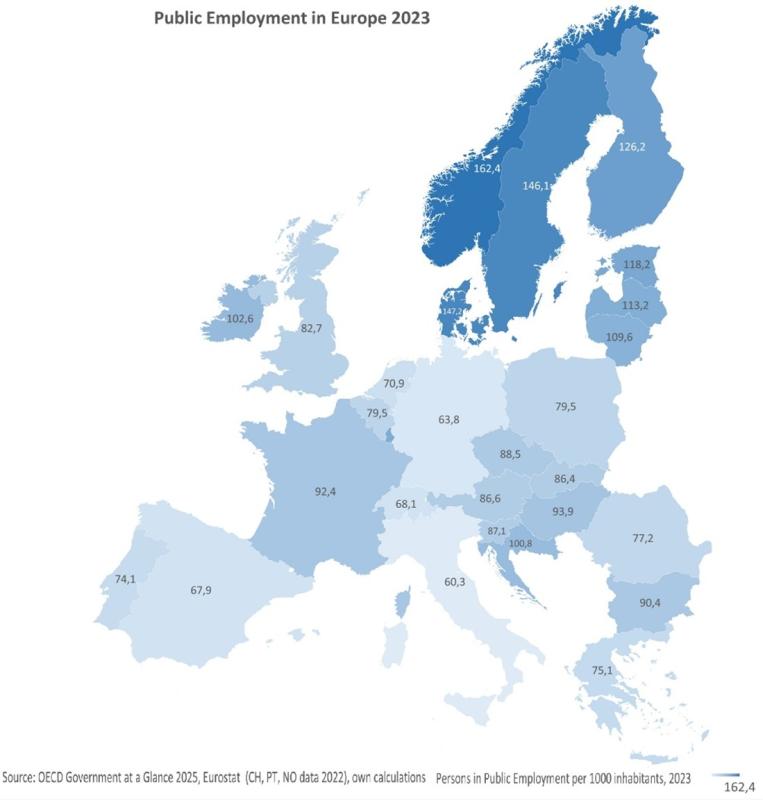
The map shows the number of persons in public employment per 1,000 inhabitants in Europe in 2023. Across the European Union, the average stands at 94.1 public employees per 1,000 inhabitants. At the same time, the variation between countries is considerable. Within the EU, Italy records the lowest value with 60.3 public employees per 1,000 inhabitants, while Denmark reaches the highest level with 147.2. This wide range illustrates substantial differences in the role and scale of the public sector across European states.
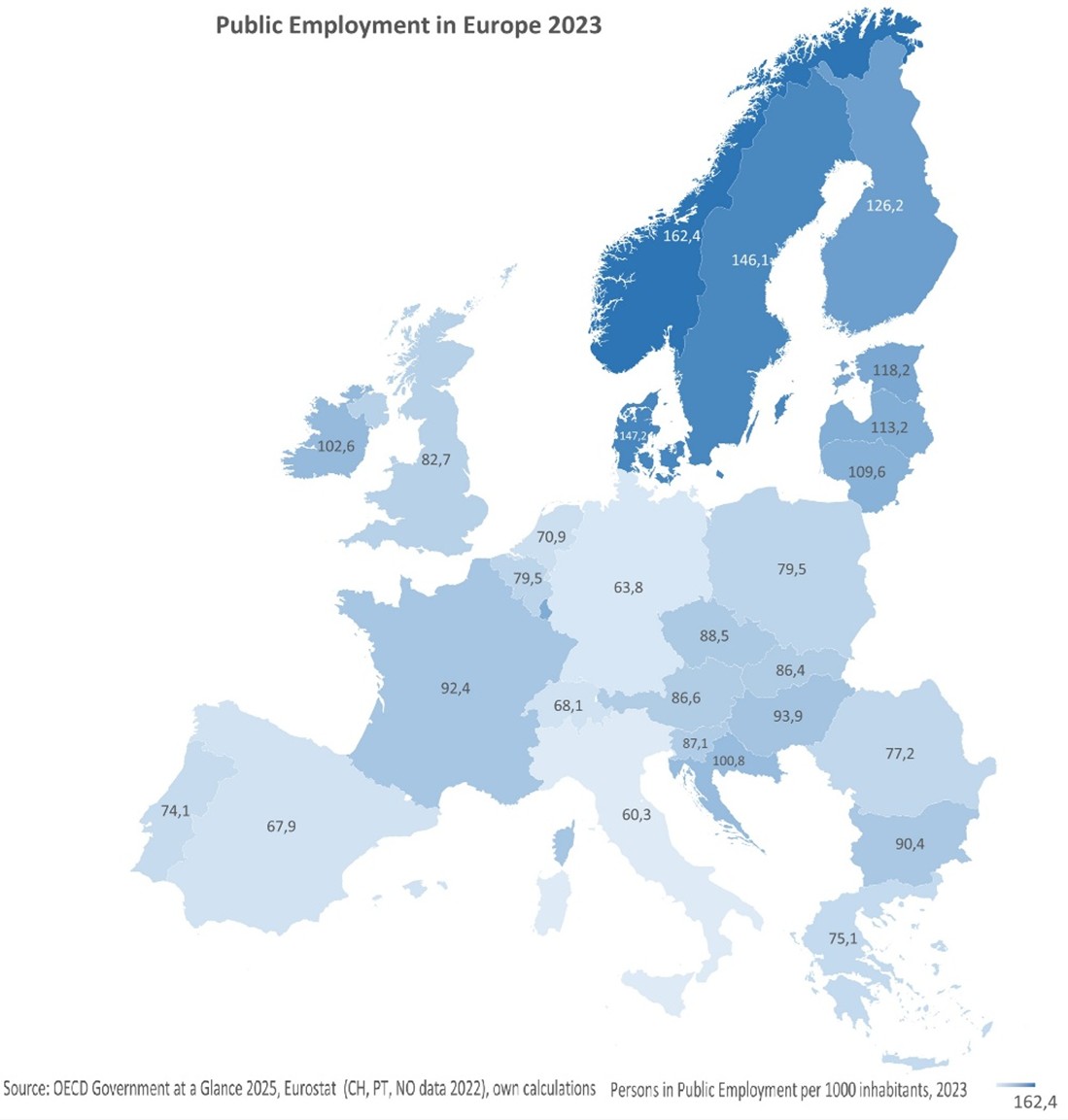
The Nordic countries stand out particularly clearly on the map, with Norway (non EU), Denmark, Sweden, and Finland all showing comparatively high values. By contrast, several Southern and Central European countries remain below the EU average, including Italy, Spain, Portugal, Germany, and Switzerland (non EU).
The map therefore provides a more nuanced picture of public employment than either absolute numbers or workforce shares alone. It highlights how strongly public services are embedded in different national systems. Higher values often point to broader public service provision and stronger welfare-state structures, particularly in areas such as education, healthcare, and social services. Lower values may reflect leaner administrative systems, different institutional arrangements, or a stronger role for private and non-state provision.
Public Employment as a Share of Total Employment
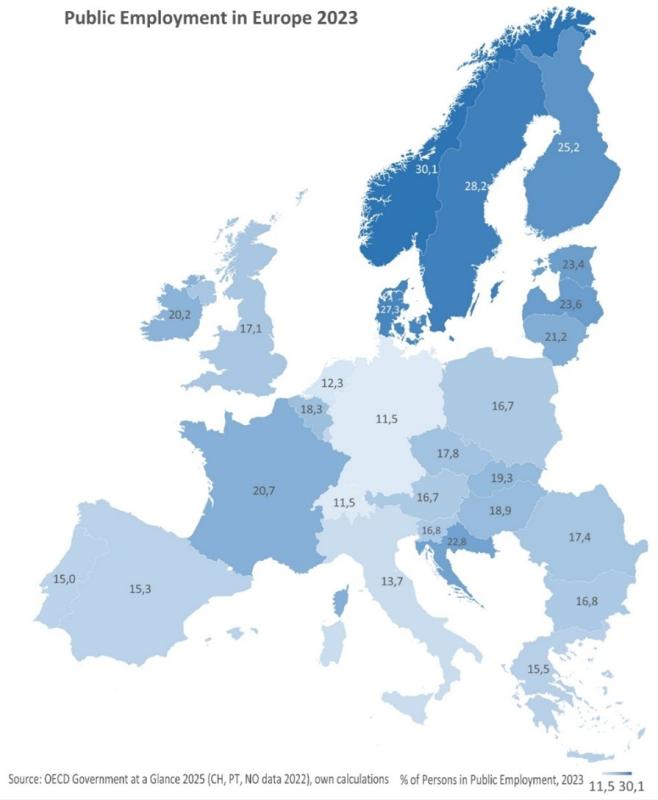
To move beyond the limits of absolute figures, public employment can be assessed as a share of total employment across Europe in 2023. This indicator provides a more meaningful basis for comparison, as it reflects the relative importance of the public sector within each country’s labour market. Across the European Union, the average share of public employment stands at 18.8%.
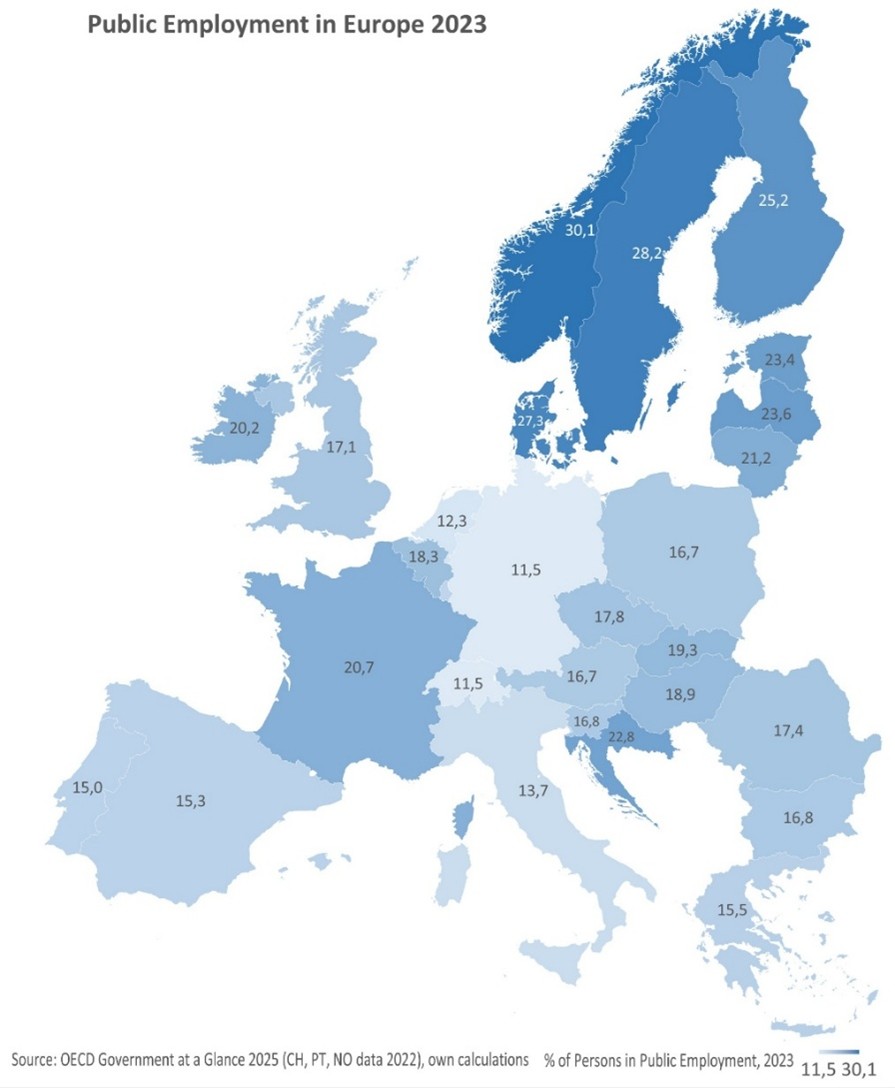
The map reveals substantial variation among countries. Germany records the lowest share within the EU, at 11.5%, pointing to a comparatively small public sector in relation to total employment. At the other end of the spectrum, Sweden shows the highest share in the EU, at 28.3%, reflecting the strong role of the public sector in Scandinavian welfare and administrative systems.
The data on public employment as a share of total employment reinforces the findings from public employment per 1,000 inhabitants. It confirms a comparatively strong public sector in countries such as Norway (non EU), Sweden, and Denmark, while Germany, Austria, and Switzerland (non EU) remain below the EU average. These differences point to varying welfare models, administrative traditions, and approaches to service delivery.
Overall, the figures underline substantial cross-country variation in the organisation of public services, with higher shares indicating a stronger public role and lower shares suggesting leaner state structures or a greater role for private and semi-public providers.
Conclusion
In the European Union, 35.272 million people work in public employment, the average is 94.1 public employees per 1,000 inhabitants, and 18.8% of the workforce is employed in the public sector. While absolute figures mainly reflect population size, the per capita and workforce indicators provide a more meaningful comparison of the relative role of the public sector. In this respect, the data point clearly to the Nordic welfare model, where countries such as Denmark, Sweden, and Norway combine high levels of public employment per capita with a high share of public employment in total employment. This underlines the stronger role of the public sector in delivering welfare services such as healthcare, education, and social care. Overall, these measures show clear differences between European countries and highlight the influence of welfare models, administrative traditions, and approaches to public service delivery.
weitere interessante
Beiträge