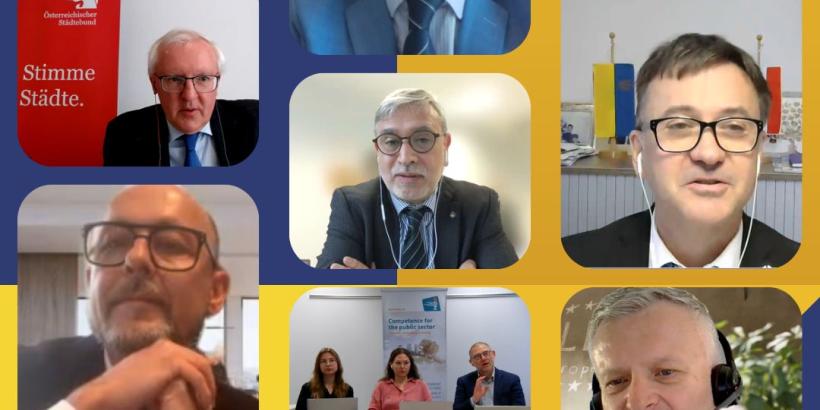
On 21 April, the European Committee of the Regions (CoR) hosted a conference bringing together some of the most concrete SDG implementation experiences currently underway: Austrian federal states, the Piemonte region, and the Joint Research Centre (JRC) working with over 20 regions. Among these key actors, we contributed from the public finance perspective, presenting KDZ’s work on the Technical Support Instrument (TSI) project “Sustainable Local Public Finances (SLPF)”, which focuses on embedding the SDGs into budgeting and financial governance at the local level.
We have summarised the most interesting key takeaways from the conference for you:
Austria: Strong Coordination, Untapped Potential
Anna Muner-Bretter (Austrian Federal Chancellery) highlighted Austria’s federal governance model, which places strong emphasis on vertical coordination between the national and regional levels.
Key elements include:
- A coordination platform of sustainability coordinators across federal and regional levels
- SDG focal points in each federal state
- Alignment efforts linked to Austria’s Voluntary National Review (VNR)
At the same time, Austria illustrates a broader European challenge: while coordination structures are in place, regional contributions such as Voluntary Local Reviews (VLRs) are not yet systematically embedded. The federal level is encouraging regions to engage more actively, including through guidance and international frameworks.
Looking ahead—especially in discussions around a post-2030 agenda—the role of regions will need to go beyond implementation towards ownership and agenda-setting.
Styria: Building Systems for Implementation
Sabine Schneeberger (Styria) presented a region that is actively translating SDGs into administrative practice. As part of a Joint Research Centre initiative (“2030 Catalyst”), Styria is developing:
- A regional SDG monitoring system, aligned with national indicators
- Close cooperation with Statistics Austria, ensuring vertical data alignment
- Exchange mechanisms with other regions (e.g. Carinthia)
- Initial steps towards SDG-oriented budgeting
Two SDG reports have already been published, demonstrating how global goals can be contextualised with regional examples. At the same time, challenges remain—particularly in communication and scaling these efforts across municipalities.
Piemonte: Policy Coherence in Action
Emanuela Elia (Piemonte Region) and Stefania Tron (IRES Piemonte) illustrated how policy coherence for sustainable development (PCSD) is moving from theory into practice.
In Italy, all 20 regions are engaged in SDG localisation, supported by national strategies and EU instruments such as the Technical Support Instrument (TSI, 2024–2026).
Piemonte’s approach focuses on:
- Aligning existing regional strategies and programmes with SDGs
- Developing monitoring systems linked to national frameworks
- Testing methodologies to identify synergies and trade-offs across policies
- Embedding SDGs into budgeting and decision-making processes
As highlighted in the discussion, this work—supported by OECD collaboration in several regions—marks a shift: policy coherence is no longer an abstract principle, but a set of concrete tools and methods.
Voluntary Local Reviews (VLRs) also play a key role here—not just as reporting exercises, but as process tools that support coordination and learning.
Beyond Indicators: SDGs as an Operational Framework
A particularly strong contribution came from Cecilia Bertozzi (Joint Research Centre), who emphasised the need to go beyond indicators.
The distinction is simple but powerful:
- Hard data (indicators) tell us what is happening
- Soft data (governance structures) explain how it happens
The real challenge lies in building the mechanisms and institutional conditions that allow regions to act on SDGs.
Her central argument resonated across the conference:
The most consequential shift is treating SDGs as an operational framework for navigating complex decisions, rather than layering them on top of existing commitments.
This reflects a broader understanding that SDGs are inherently holistic and cannot be implemented in silos. They require integrated governance, cross-sectoral coordination, and shared objectives across levels of government.
KDZ Contribution: Sustainable Local Public Finances
Within this broader discussion, Thomas Prorok (KDZ) and colleagues presented the Sustainable Local Public Finances (SLPF) TSI project funded by the European Commission and implemented by four European Cities (Amsterdam, Barcelona, Bordeaux and Hamburg), highlighting the importance of aligning financial systems with SDG objectives.
The core message resonates strongly with the conference themes:
Without integrating SDGs into budgeting, financial planning, and fiscal governance, localisation efforts remain incomplete. Public finance is not just a technical issue—it is a key lever for turning SDG strategies into reality.
Conclusion
The conference highlighted that while strong progress is being made on SDG localisation, the focus is already shifting beyond the 2030 Agenda. Regions and cities are not only key to delivering the current goals through better coordination, policy coherence, and integration into budgets, but are also essential in shaping what comes next. As discussions on a post-2030 framework gain momentum, the experiences, tools, and governance innovations developed at the local and regional level will be critical in informing a more practical, integrated, and implementable future sustainability agenda.
Related
News